You are here: Home > lock0844 875 1260

Posts Tagged ‘lock’

Wallbridge Lock gets news head and tail gates

Thursday, December 22nd, 2011

New head and tail gates were succesfully fitted to the lock chamber on Tuesday 13th December.

Cotsworld Canals Restoration - Land & WaterThe Hargreaves team who built the gates, supported by the Land & Water site team and of course the Ellis Crane Hire crew, had all four gates in place by mid afternoon. Then the really hard work began… installing the gate cills, fitting the cheek timbers and connecting the paddle gear. This work continues.

Silt re-sited

The dredged silt, previously contained in a drainage lagoon within the site compound, has been transported to the prepared tipping area below the lock. 

This material will continue to dry before being landscaped to form an amenity area.

Using the dredgings to enhance the bridge site gives the project the best possible outcome in terms of environmental benefit and off-setting the scheme’s carbon footprint.

Volunteer Engineers

Cotswold Canals Trust Volunteers arrived on site on Friday and commenced installation of the ground paddle jack posts and gearing. In spite of the the extremes of weather experienced in recent days the site teams, professional and volunteers alike, have carried on with the job in hand.

Teetering on the Edge

Loose coping stones on the towpath edge above the lock were in danger of falling into the canal. The stones have been removed and reseated onto on a mortar bed. This work continues.

Read more at the Cotsworld Canal Trust 

Papermill Lock Bank Revetment Works

Tuesday, October 5th, 2010

The existing piled revetment works were failing and support was required for the riverbanks, both up and down stream of the lock and weir.

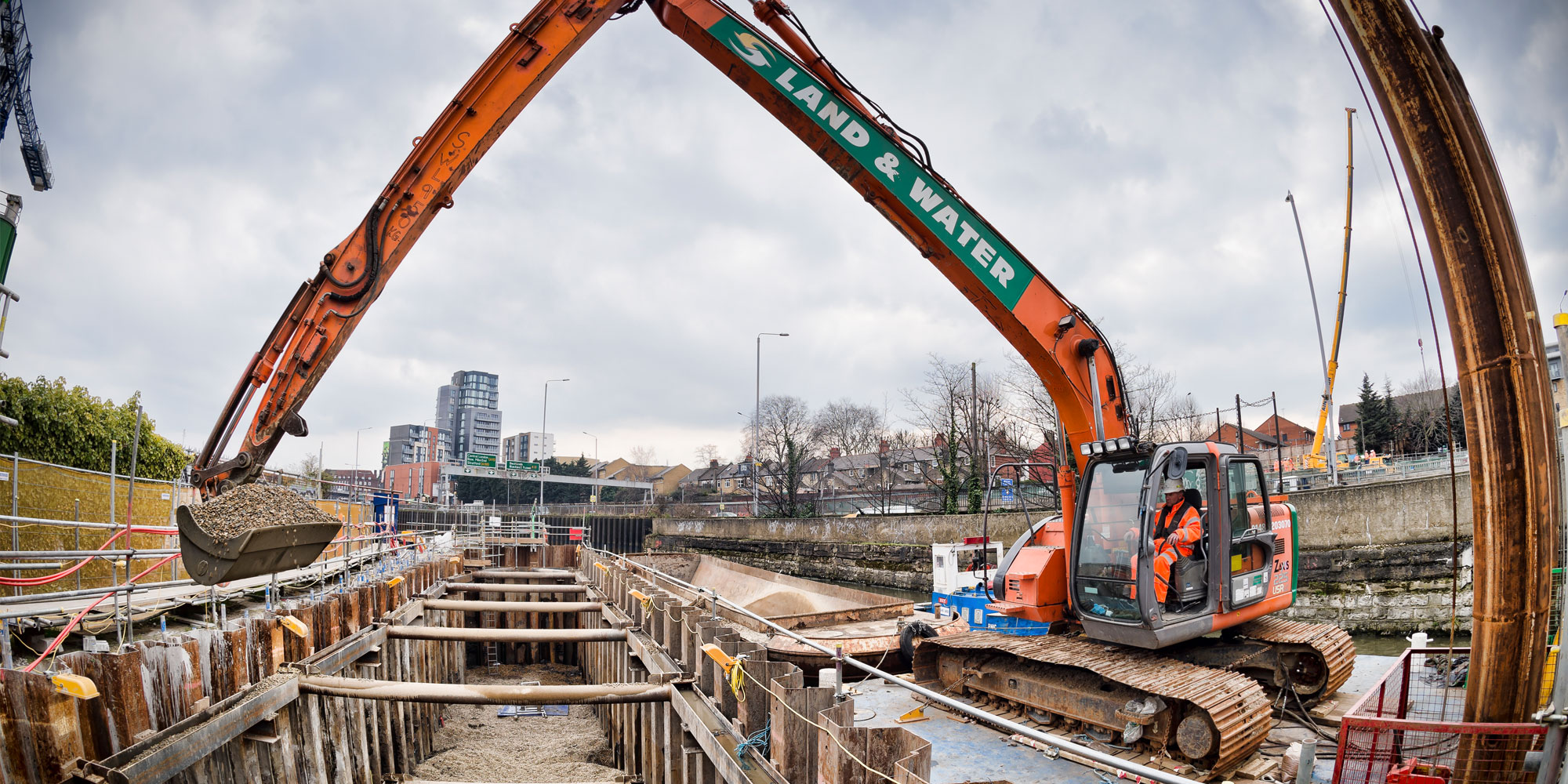
Papermill Lock Land & Water Case StudyDue to restricted access, the works had to be carried out using floating equipment. Downstream and adjacent to the weir, new 7m long sheet piles were driven in front of existing piles using Land & Waters Movax pile driving attachment.

Granular dredgings from the river were then extracted and used to backfill behind the new pile line. Along the edge of the by-pass channel, galvanised steel sheet piles were driven at the bank edge and tied back to anchor piles. These again were back filled between the structures using granular material recovered from the river. Further revetments were required to shore up banks.

This was completed by using 4mm galvanised weld mesh panels behind timber posts filled behind with gabion stone. Finally, a timber oak coping and rubbing strip was attached giving both fender protection and pleasing aesthetics.

All works were carried out safely within a busy public area with all parties being pleased with the result.

Papermill Lock Before - Land & Water Case StudyPapermill Lock After - Land & Water Case Study


Cossington Lock Restoration

Sunday, August 30th, 2009

The Cossington lock approach was composed of York stone block work wall and a granite setts footpath, this had become unstable and was slipping into the canal due to floodwater erosion. The site is a British Waterways heritage site and this had to be reflected in the reconstruction works.

Cossington Lock Restoration Land & Water Case StudyOutline of works: – Recover stones and setts for re-use, install 55m of sheet piles, construct two course stone wall over piles and relay the footpath with setts.

The site is remote with footpath access only. All plant, materials and welfare must be brought to site via the canal.

The existing wall was demolished and the stones reclaimed for later use, all concrete arisings were stored in hopper barges for use as back fill material. The pile line consisted of five metre long  piles which were driven by a excavator mounted piling hammer on a road transportable pontoon with spud legs. The soffit comprised of steel plate welded to the top of the piles. Backfill to the piles was reclaimed concrete from site with a 95% reuse of waste materials being achieved. Imported backfill materials and concrete were sourced from a local quarry which was collected via the canal. The stone blocks were placed by the excavator mounted on the pontoon with hydrated lime mortar used for jointing.

The finished footpath consisted of stone setts and fine gravel.

Cossington Lock Restoration in progress Land & Water Case Study

Cossington Lock Restoration in progress overview Land & Water Case Study